
pediatric EHR
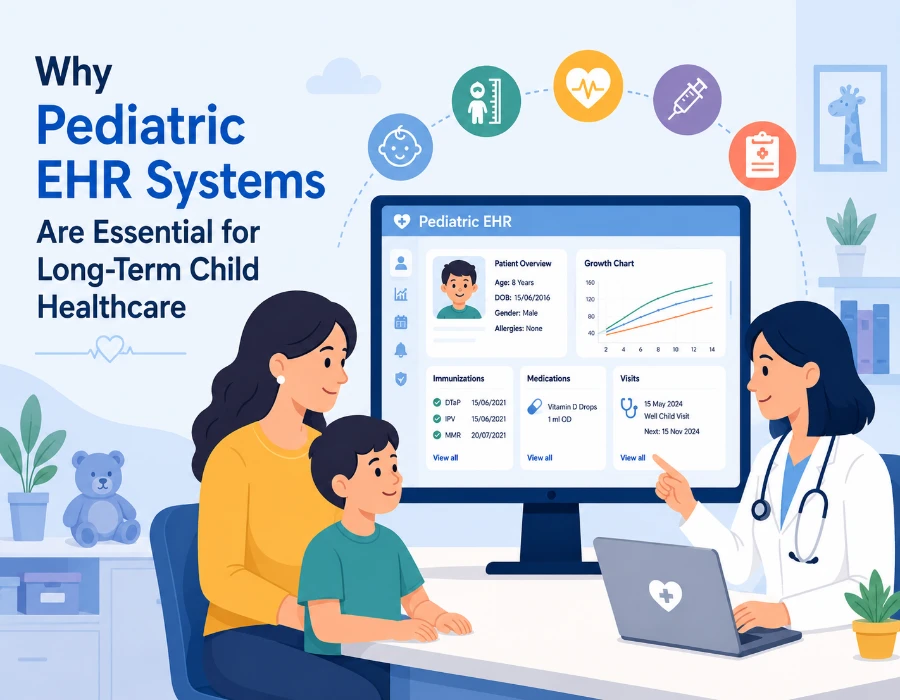
Every paediatrician knows this moment: a mother walks in with her seven-year-old, worried about a recurring fever. You try to recall — was there a similar episode last year? What antibiotics were prescribed? Are there any documented allergies? If you're working off paper files or a generic clinic software, finding that information quickly is a genuine challenge. Now multiply that across 40–60 patients a day, and you begin to understand why pediatric EHR systems are no longer a luxury — they're a clinical necessity.
India's paediatric healthcare landscape is evolving fast. Parents are more informed, follow-up expectations are higher, and the complexity of managing a child's health from birth through adolescence demands more than memory and manila folders. A dedicated pediatric EHR is built precisely for this — to give doctors the complete picture, instantly.
The Complexity of a Child's Medical Journey
Unlike adult patients, children don't stay the same. Their bodies, immune systems, developmental markers, and medication tolerances change every few months. A record that made sense at age two looks very different by age ten.
What needs to be tracked across that journey?
Growth charts — height, weight, BMI, head circumference, plotted over time and benchmarked against WHO/IAP standards
Immunisation history — which vaccines were given, when, and what's pending as per the national schedule
Allergies and adverse reactions — drug allergies, food sensitivities, prior reactions to vaccinations
Developmental milestones — speech, motor skills, social behaviour, school performance flags
Medication history — dosages adjusted for weight and age, previous prescriptions, antibiotic exposure
Family medical history — genetic risks, hereditary conditions, sibling health patterns
No single visit captures all of this. It accumulates over years. A pediatric EHR is the system that holds all of it together — structured, searchable, and always accessible.
Why Generic Software Falls Short
Many clinics in India currently use billing software, generic EMRs, or simple practice management tools that weren't built with paediatrics in mind. The result? Doctors end up maintaining parallel systems — one digital, one paper — which defeats the purpose entirely.
Generic tools don't have age-adjusted medication calculators. They don't flag overdue immunisations. They don't display a child's growth trend on a visual chart so you can spot a concerning dip in the third percentile. These aren't cosmetic features — they're clinical tools that directly affect the quality of care.
This is exactly where a purpose-built solution like PediaOps makes a meaningful difference. Designed specifically for paediatric clinics in India, PediaOps brings together all the above data points in one coherent, easy-to-navigate interface — so your clinical attention stays on the patient, not the paperwork.
Better Records Mean Better Clinical Decisions
Think about what a complete pediatric EHR enables a doctor to do:
At each visit, the doctor can see the child's full history at a glance — last consultation notes, current medications, pending vaccinations, growth trend, and any flagged concerns from previous visits. That's context that changes how you think about a presenting symptom.
For chronic conditions like recurrent wheezing, anaemia, or growth concerns, tracking data over time helps distinguish patterns from isolated incidents. Is this the third time in six months? That's clinically significant. A good pediatric EHR makes that visible without the doctor having to dig through files.
For medication prescribing, having the child's current weight and allergy history available in real time reduces the risk of errors. PediaOps, for instance, supports weight-based dosage guidance, which is especially useful for busy OPDs where doctors are prescribing under time pressure.
For parent communication, having structured data allows doctors to show parents their child's growth chart, explain where they stand, and set expectations — which builds trust and improves compliance with treatment plans.
The Immunisation Tracking Problem in Indian Clinics
Immunisation management deserves its own mention because it's one of the most common operational pain points in Indian paediatric practice. Parents forget which vaccine is next, show up with incomplete records, or visit different clinics for different doses.
A pediatric EHR with a built-in immunisation scheduler — mapped to IAP and government schedules — can flag what's due, what's pending, and send automated reminders to parents. This doesn't just improve individual patient outcomes; it improves your clinic's overall immunisation completion rates and reduces the "which vaccine next?" conversation at every visit.
PediaOps includes exactly this kind of structured immunisation tracking, helping clinics manage their entire patient population's vaccine schedules without relying on parent-maintained booklets alone.
Long-Term Value: From Birth to Adolescence
Here's the longer view: a child who first visits your clinic at two weeks old might continue seeing you until they're 16. That's potentially thousands of data points, dozens of illnesses, several developmental assessments, and a complete vaccination record. If you've maintained that in a well-structured pediatric EHR, you have something genuinely valuable — a longitudinal health record that tells a complete story.
For the doctor, it means more informed care at every stage. For the parent, it means trust in a clinic that knows their child's history. For the child, it means health decisions made with full context rather than guesswork.
Systems like PediaOps are built with this long arc in mind — not just today's OPD queue, but the ongoing relationship between a paediatrician and the families they serve.
The Bottom Line
If you're still running your paediatric clinic on paper registers, generic billing software, or disconnected tools, you're carrying an operational burden that a dedicated pediatric EHR can significantly reduce. More importantly, you're making clinical decisions without the full picture.
Investing in the right system — one built for paediatrics, not adapted from adult medicine — is one of the most practical things a growing clinic can do. PediaOps was built for exactly this purpose: to give Indian paediatricians a tool that understands the unique demands of their practice, from the first well-baby visit to the last adolescent consultation.
Frequently Asked Questions (FAQs)
1. What is a pediatric EHR and how is it different from a regular EMR? A pediatric EHR (Electronic Health Record) is a digital record system designed specifically for children's healthcare. Unlike generic EMRs, it includes features tailored to paediatrics — growth chart tracking, age-adjusted medication calculators, immunisation schedulers mapped to IAP/government schedules, and developmental milestone documentation. Tools like PediaOps are built from the ground up for paediatric clinics, rather than being generic software adapted for child health.
2. How does a pediatric EHR help with immunisation management? A dedicated pediatric EHR tracks each child's vaccination history against standard immunisation schedules, flags upcoming or overdue vaccines, and can send automated reminders to parents. This reduces dependency on parent-maintained vaccine booklets and helps clinics maintain better immunisation completion rates across their patient base.
3. Is a pediatric EHR useful for small or solo paediatric clinics, or only for large hospitals? It's arguably more useful for solo and small clinics, where a single doctor is managing high patient volumes without dedicated administrative support. A system like PediaOps is designed with the independent paediatrician in mind — helping manage OPD flow, patient records, and follow-ups without requiring a large team to operate.
4. How does maintaining detailed records improve clinical decision-making? When a doctor can see a child's complete history — past illnesses, medications, allergies, growth trends, and developmental milestones — in a single view, they can make faster and more accurate clinical judgements. Patterns that would be invisible across scattered paper files become clear in a structured pediatric EHR, especially for recurring conditions or chronic health concerns.
5. What data should a good pediatric EHR capture? A comprehensive pediatric EHR should capture growth parameters (height, weight, BMI, head circumference), vaccination records, allergy and adverse reaction history, developmental milestone assessments, prescription and medication history, visit notes, family medical history, and investigation reports. PediaOps is structured to capture all of these in a paediatric-specific format.
6. How do I transition my existing clinic from paper records to a pediatric EHR? The transition is typically phased — starting with new patients on the digital system while gradually digitising existing records over time. A good software provider will offer onboarding support and data migration assistance. With PediaOps, the interface is intuitive enough that most clinic staff adapt within a few days, making the switchover less disruptive than most doctors expect.
Related articles
More reading from Clinic-Ops on similar clinic workflows.